Align 4
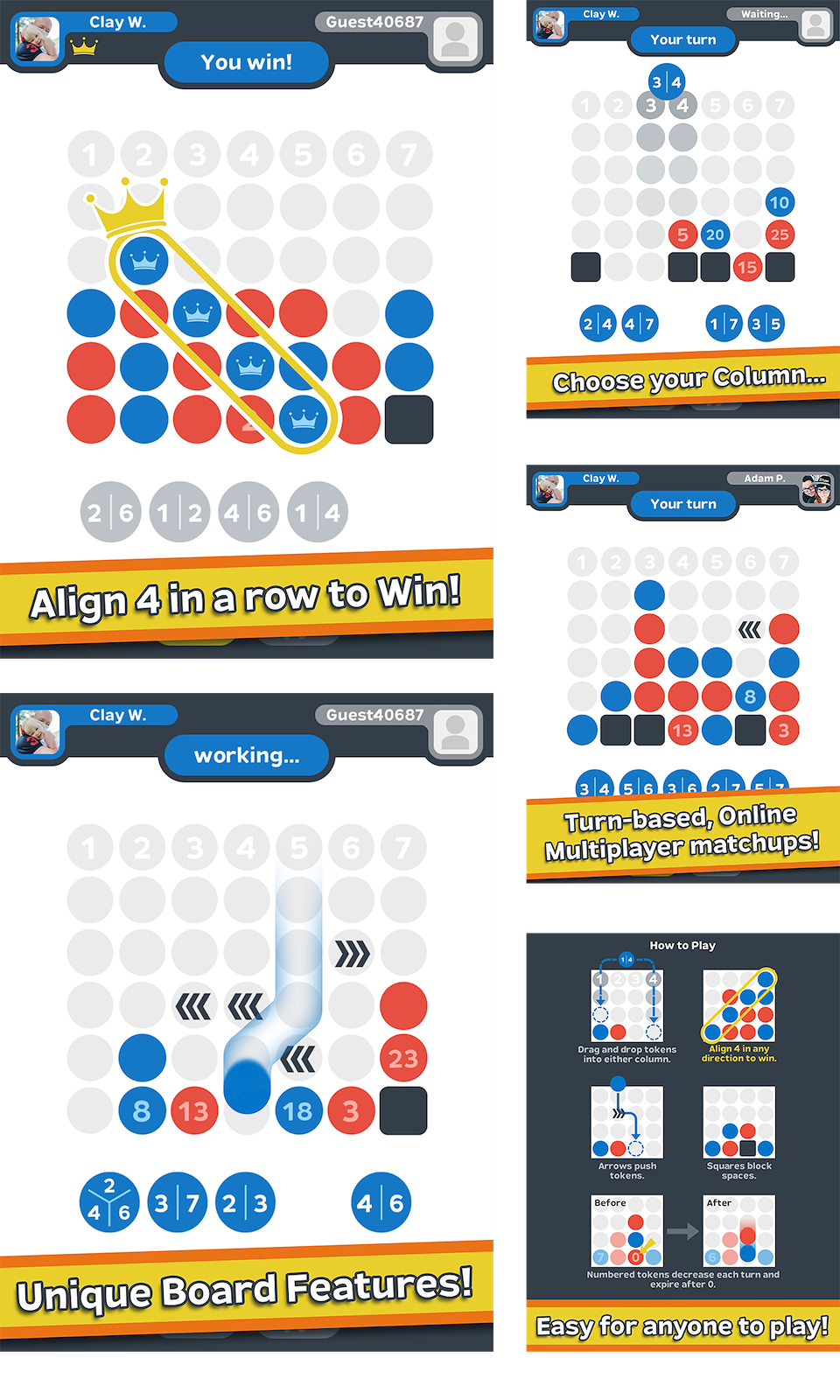
For Align 4, I wanted to preserve the accessibility and and simplicity of Connect 4 while creating a game that rewarded adaptation, strategy, and creative problem solving. Working remotely with a programmer in Paris, I designed and shipped the game from concept to release, owning every aspect of development outside of programming, including gameplay systems, balance, UX, art direction, and creative vision.
Unsolving the Game
Traditional Connect 4 has been mathematically solved, meaning optimal play always leads to a predictable outcome. To introduce meaningful decision making, I designed a token system where each player draws a hand of five tokens from identical player decks. The system introduced controlled randomness that rewarded strategic thinking without allowing luck to consistently determine the winner.
Making Every Turn Matter
One of my primary design goals was eliminating the uneventful opening turns common to Connect 4. Every match of Align 4 begins with five randomly dropped starting tokens, immediately creating meaningful decisions instead of predictable, repetitive opening moves.
Those opening pieces don’t remain static. Every fifth turn, one of them expires, forcing players to continuously reassess the board as opportunities and threats evolve. This system also offsets the traditional first-player advantage, since the starting player begins with two pieces already on the board while the second player begins with three, offsetting the advantage of taking the first turn.
Endless Variety
To keep matches feeling fresh, I designed a procedural board generation system that introduced environmental modifiers. Some boards contained permanent blockers that altered player strategy, while others featured moving pushers that shifted pieces between columns throughout the match. These elements encouraged players to adapt rather than rely on memorized openings, making each game feel distinct.
What I Learned
Align 4 taught me one of the most valuable lessons of my career: great design isn’t about how many ideas you can fit into a game—it’s about knowing which ones deserve to stay. Early versions were considerably more ambitious, but every feature had to justify the complexity it introduced. Simplifying the design ultimately made the strategy clearer, the decisions more meaningful, and the game more enjoyable. That lesson has stayed with me on every project since.
Role |
Founder & Game Designer |
For |
Wedgy Games |